Accreditation
Southwestern Oklahoma State University’s Department of Education educator preparation programs are accredited under the Council for the Accreditation of Educator Preparation (CAEP) standards, for a period of seven years, from Fall, 2020, to Fall, 2027.
Initial-Licensure Programs: Art, Early Childhood, Elementary Education, English Education, Health and Physical Education, History Education, Instrumental Music, Mathematics, Natural Science Education, Special Education, and Vocal Music
Advanced Programs: Education Administration-Building Level, Educational Administration-District Level, Reading Specialist, School Counseling, and School Psychology

Annual Reporting Measures
- 2023-2024 CAEP Annual Reporting Measures
- 2022-2023 CAEP Annual Reporting Measures
- 2021-2022 CAEP Annual Reporting Measures
- 2020-2021 CAEP Annual Reporting Measures
Annual Reports
CAEP Accountability Measures
Measure 1: Completer effectiveness and Impact on P-12 learning and development (Initial Licensure Programs)
Southwestern Oklahoma State University (SWOSU) utilizes the Oklahoma Teacher and Leader Effectiveness (OKTLE) system as evidence to meet CAEP Standard R4.1 (Measure 1), which requires Educator Preparation Providers (EPPs) to demonstrate that completers positively impact P–12 student learning and effectively apply professional knowledge, skills, and dispositions in classroom settings. The OKTLE system, approved by the Oklahoma State Department of Education (OSDE) and the Office of Educational Quality and Accountability (OEQA), provides standardized, externally validated evaluation data. OSDE collects and submits Teacher and Leader Effectiveness (TLE) data to OEQA, which then shares the data with SWOSU for analysis and reporting.
The OKTLE rubric employs a rigorous five-point performance scale (1 = Ineffective,
2 = Needs Improvement, 3 = Effective, 4 = Highly Effective, 5 = Superior) and evaluates
completers across five domains: Classroom Management, Instructional Effectiveness,
Professional Growth and Improvement, Interpersonal Skills, and Leadership. Within
these domains, trained district evaluators assess multiple indicators aligned with
professional teaching standards, ensuring consistency and objectivity.
SWOSU’s 2024–2025 data demonstrate that program completers are meeting and exceeding
expectations. The overall Instructional Effectiveness score of 3.703 exceeds the “Effective”
benchmark, indicating strong performance in applying instructional practices. Completers’
impact on student-learning growth is evidenced through key dimensions such as Student
Achievement (3.421), Monitors (3.712), and Adjusts Based Upon Monitoring (3.619),
all of which reflect the ability to use assessment data to guide instruction and improve
student outcomes. Additionally, professional dispositions are demonstrated through
a high Professional Accountability score (3.897), reflecting consistency, reliability,
and adherence to professional standards.
Student-learning growth is measured through dimensions such as Student Achievement
and Adjusts Based Upon Monitoring, which evaluate a teacher’s responsibility for student
success and ability to refine instruction based on data. The application of professional
knowledge and skills is captured within the Instructional Effectiveness domain, including
indicators such as explaining content and modeling. Professional dispositions are
further assessed through dimensions such as Professional Accountability and Interpersonal
Skills.
By utilizing a standards-based, state-approved evaluation system with clearly defined
performance benchmarks, SWOSU is able to provide high-quality, objective evidence
of completer effectiveness. Achieving a rating at or above “Effective” signifies that
completers consistently implement instructional strategies, use assessments to monitor
learning, and support student development. These data provide compelling and consistent
evidence that SWOSU completers positively impact P–12 student learning and demonstrate
the professional competencies.
Measure 2 (Initial and Advanced): Satisfaction of employers and stakeholder involvement. (R4.2|R5.3| RA4.1)
Mentor/Administrator Survey OEQA administers the Mentor/Administrator Survey to mentors/administrators within the state who have hired the EPP’s graduates as first-year teachers. The survey is aligned to the InTASC standards and seeks information from mentors/administrators about the EPP’s program completer preparedness and overall satisfaction with the SWOSU Department of Education graduates. The survey uses a Likert rating scale of 1 – 4 with 1=Strongly Disagree; 2=Disagree; 3=Agree; 4=Strongly Agree to each of the statements. No data was provided from the Oklahoma State Department of Education for the Mentor/Administrator Survey for 2022-2023. Data on completers for 2022-2023 will be provided when the current Memorandum of Understanding for the data-sharing agreement is approved by the Oklahoma State Department of Education.
Measure 2 (Initial and Advanced): Satisfaction of employers and stakeholder involvement. (R4.2|R5.3| RA4.1)
Mentor/Administrator Survey OEQA administers the Mentor/Administrator Survey to mentors/administrators within the state who have hired the EPP’s graduates as first-year teachers. The survey is aligned to the InTASC standards and seeks information from mentors/administrators about the EPP’s program completer preparedness and overall satisfaction with the SWOSU Department of Education graduates. The survey uses a Likert rating scale of 1 – 4 with 1=Strongly Disagree; 2=Disagree; 3=Agree; 4=Strongly Agree to each of the statements. No data was provided from the Oklahoma State Department of Education for the Mentor/Administrator Survey for 2022-2023. Data on completers for 2022-2023 will be provided when the current Memorandum of Understanding for the data-sharing agreement is approved by the Oklahoma State Department of Education.
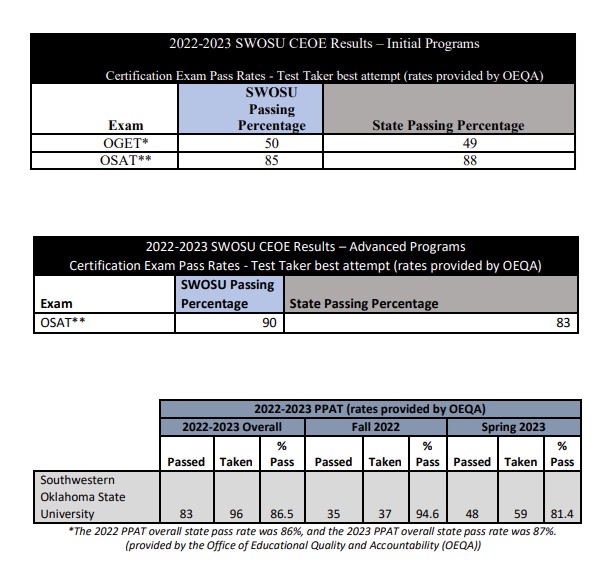
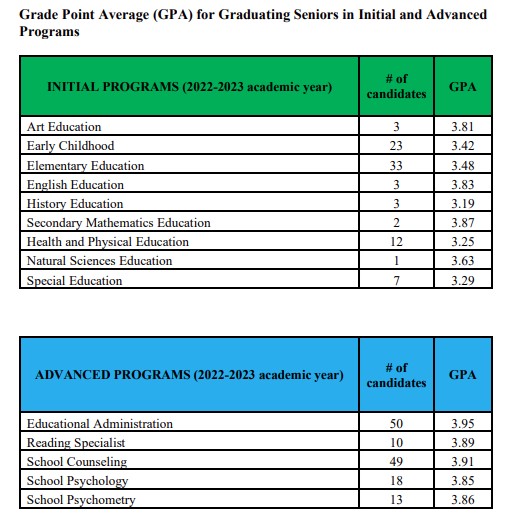
Title II Report Part A of Title II includes provisions on program accountability and evaluation (program data collection, state and institutional report cards, and identifying low-performing programs). Part A of Title II also features the Teacher Quality Partnership grant program, the only federal initiative designed to strengthen and reform teacher preparation in concert with higher education. Part B of Title II features provisions for increasing educator diversity, educator use of technology in classrooms, and the creation of an adjunct teacher corps to recruit and train individuals with subject matter expertise to staff high-need fields. Additionally, Part B includes a grant program to prepare general education teachers to educate students more effectively with disabilities. The 2024 Title II Report for academic year 2022-2023 and all Title II Reports can be found at this link.
Measure 4: Ability of Completers to be Hired in Education Positions for Which They Have Been Prepared (Initial and Advanced Licensure Programs)
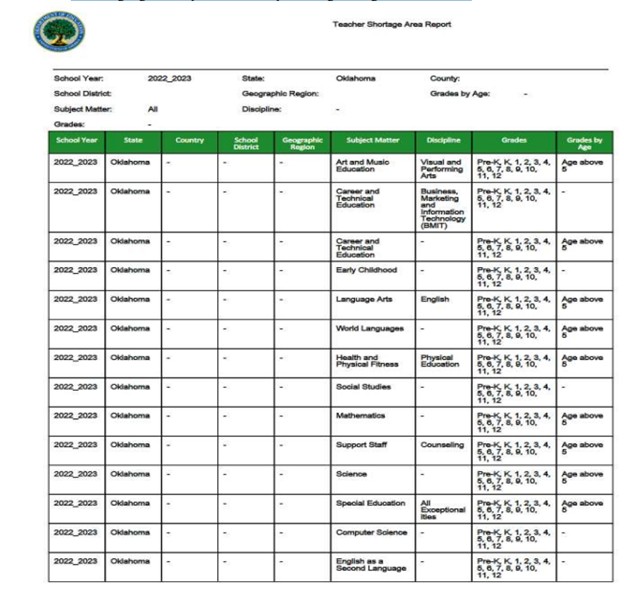
U.S Department of Education Teacher Shortage Areas Report for Oklahoma In Oklahoma, there exists a severe scarcity of teachers for both elementary and secondary grades across various subject areas. The need for educators is high across all certification fields. The United States Department of Education has furnished the following report, which highlights the specific areas experiencing shortages in Oklahoma.
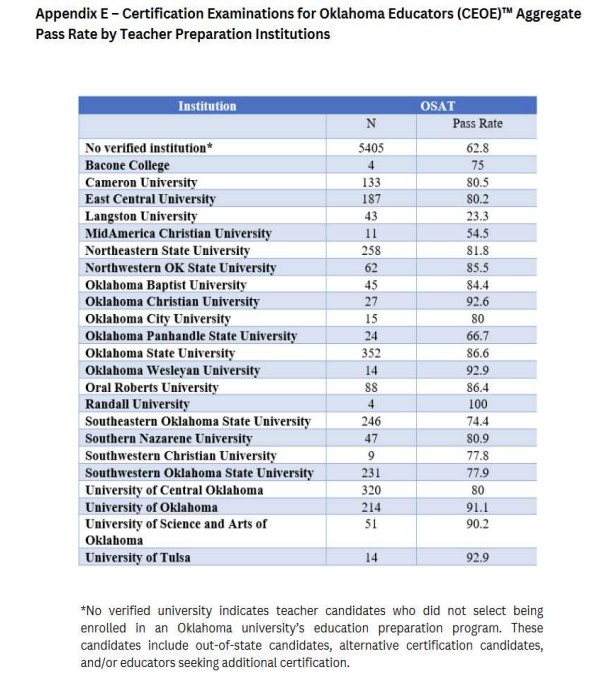
Certification Examinations for Oklahoma Educators (CEOE) Aggregate Pass Rate Each year, OEQA provides an annual report to EPPs. The report includes program accreditation status of all EPPs in Oklahoma as well as the CEOE aggregate pass rate by test and institution for each academic year. Below is the OSAT aggregate pass rate for all institutions. All annual reports can be found at this link.